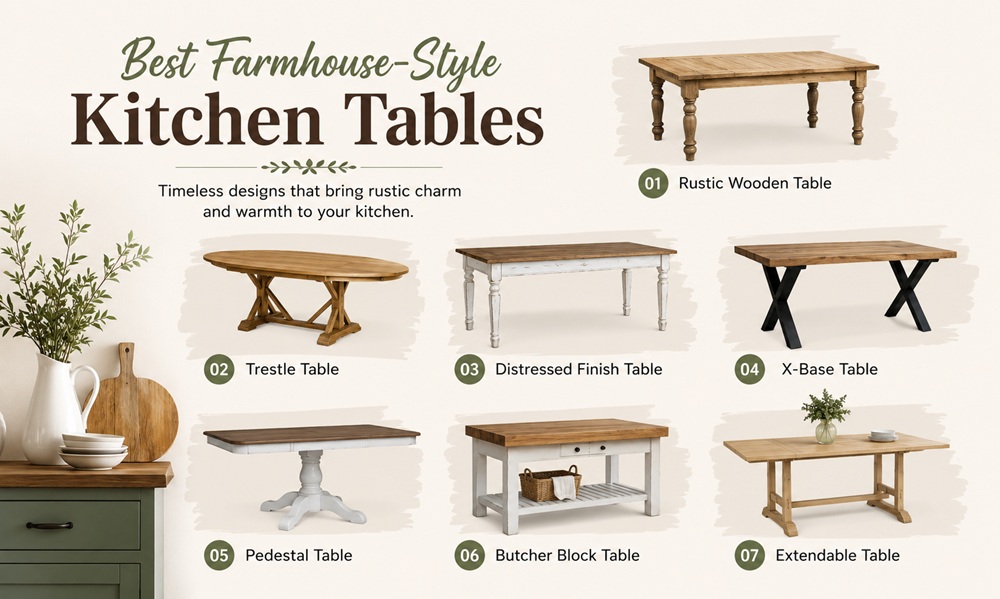
The best kitchen table shape depends on your room size and layout: round tables work best in small or square kitchens since they avoid sharp corners in walkways, rectangular tables suit long, narrow rooms and larger families, and square tables fit compact kitchens where you need efficient seating for four. There isn’t one universally best shape, only the best shape for your specific space.
Picking a table shape is one of those decisions that seems simple until you’re standing in the kitchen trying to picture how it will actually work. Here are the questions people ask most when narrowing it down.
What Is the Best Table Shape for a Small Kitchen?
Round tables tend to work best in small kitchens. Without corners, people and chairs can navigate around a round table more easily in a tight room, and round tables generally require less total floor space for the same number of seats compared to rectangular options. A 36-inch round table comfortably seats four without feeling as bulky as a rectangular table sized to fit the same group.
Why Does Shape Matter for Small Kitchens?
Corners are the main issue. In a small kitchen, a rectangular table’s corners often end up jutting into walkways or close to countertops, creating pinch points where people have to squeeze past. Round and oval tables eliminate this problem since there’s no sharp edge to navigate around, which makes the room feel more open even at the same table size.
How Does a Rectangular Table Perform in Larger Rooms?
Rectangular tables are the standard choice for larger kitchens and dining areas because they seat more people efficiently and fit naturally against a wall or in the center of a long room. They also make it easier to extend seating with a leaf insert, since the shape lends itself to adding length without disrupting the table’s proportions. Families who regularly host larger groups tend to prefer rectangular tables for this flexibility.
Can You Mix Shapes in Open Kitchens?
Yes, and it’s fairly common in open-concept homes. A round table can work well as the primary eating area while a rectangular island or bar-height counter handles additional seating or food prep. Mixing shapes this way can actually improve traffic flow, since the round table softens the transition between the kitchen and living areas while the rectangular counter defines the kitchen’s working zone.
What About Square Tables?
Square tables are a strong choice for kitchens that need to seat exactly four people in a tight footprint. They tend to look best in kitchens with a strong square or symmetrical layout, since an oddly shaped or long room can make a square table look out of place. Square tables under 40 inches per side are common in apartment kitchens and breakfast nooks.
Oval Tables: A Middle Ground
Oval tables combine some benefits of both round and rectangular shapes. They avoid sharp corners like round tables but offer more seating capacity along the length, similar to a rectangular table. This makes them a good option for medium-sized kitchens that want the traffic-flow benefits of a round table without sacrificing too much seating capacity.
Shape Comparison by Room Size and Seating
| Shape | Best Room Size | Typical Seating | Traffic Flow |
| Round | Small to medium | 2-6 | Best in tight spaces |
| Square | Small | 4 | Good, but corners matter |
| Rectangular | Medium to large | 4-8+ | Best for larger groups |
| Oval | Medium | 4-8 | Good balance |
Matching Shape to Your Kitchen Layout
If your kitchen is closer to square in its overall footprint, a round or square table generally looks and functions better than a rectangular one, which can feel cramped against square walls. If your kitchen is long and narrow, a rectangular table usually makes better use of the space, since it can run parallel to the room’s longest dimension without leaving awkward gaps.
Consider also where the table sits relative to major appliances. A table positioned near the stove or refrigerator benefits from a rounder shape that reduces the risk of corners catching on cabinet doors or blocking foot traffic during meal prep.
Making the Final Call
There’s no single correct shape, only the shape that matches your room’s proportions and how many people you typically feed. Measuring your available space, marking it out, and considering your household’s real seating needs will get you further than picking a shape based on trends alone.
How Shape Affects Conversation and Gathering
Beyond traffic flow, table shape also affects how people interact while seated. Round and square tables tend to encourage more natural conversation since everyone is roughly equidistant from each other, without anyone sitting at a distant “end” of the table. Rectangular tables, especially longer ones, can create a more formal dynamic where people at opposite ends may feel disconnected from the conversation happening at the other end.
For households that value casual, everyday gathering over formal dinner parties, this is worth factoring in alongside the practical space considerations. A round table in an open-plan kitchen often ends up being the spot where people naturally linger, precisely because the shape doesn’t create a hierarchy of seating positions the way a long rectangular table can.
Real Examples From Different Kitchen Layouts
In a narrow galley kitchen, a 42-inch round table tucked into one end typically outperforms a rectangular table of similar seating capacity, since the round shape avoids catching corners against cabinetry during meal prep. In an L-shaped kitchen with an open dining nook, a rectangular table often makes better use of the deeper, more regularly shaped space available in the nook itself. In a small square kitchen with limited floor space overall, a square table matching the room’s proportions tends to look more intentional than a round or rectangular table that doesn’t align with the room’s natural lines.