
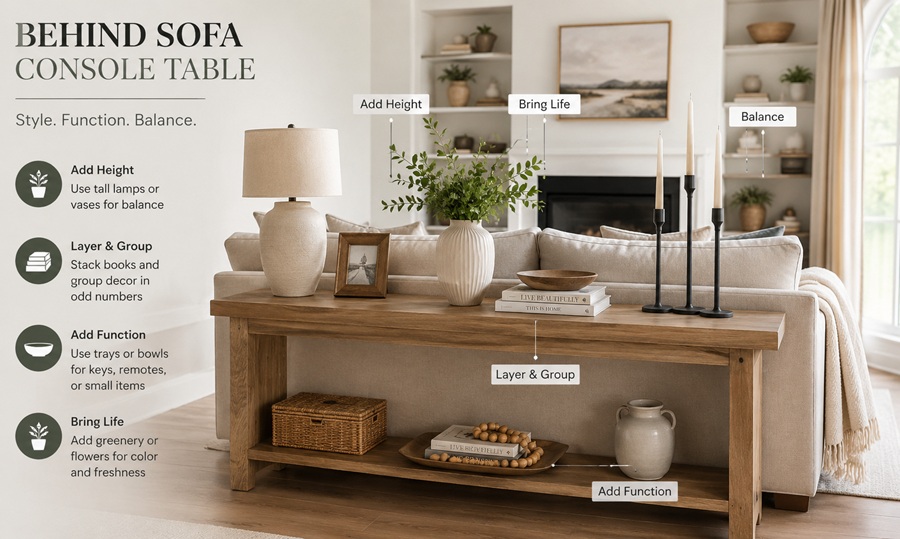
The ideal console table behind a sofa sits 2 to 4 inches shorter than the sofa’s back, runs about two-thirds to three-quarters of the sofa’s total length, and stands 1 to 3 inches taller than the sofa back if it’s floating in the middle of a room, or level with it if it’s pushed against a wall. Getting these three numbers right is what separates a console table that looks intentional from one that looks like it wandered in from another room.
Checklist: Measure Before You Buy
Take these five measurements before shopping, and bring them with you or keep them on your phone.
- Sofa back height — measure from the floor to the top of the sofa’s backrest.
- Sofa length — measure the full length of the sofa, arm to arm.
- Available depth behind the sofa — measure from the sofa back to the nearest wall, walkway, or obstacle.
- Walkway clearance — leave at least 30 inches behind the table if people need to pass through, and at least 12 inches if it’s simply a display surface against a wall.
- Outlet or lamp placement — note where nearby outlets sit if you plan to add a lamp on top.
Detailed Guide: Floating Sofas vs. Wall-Backed Sofas
A floating sofa — one positioned away from the wall to divide a room — is the classic setup for a behind-sofa console table, since the table fills the gap and gives the back of the sofa a finished look from the entry side of the room. In this layout, the table should stand slightly taller than the sofa back, both to visually anchor the piece and to keep the sofa’s back cushions from blocking a lamp or décor placed on top.
When a sofa sits flush against a wall, a traditional console table doesn’t have room to fit behind it. In that case, a slim console can go along a side wall instead, or homeowners skip the console entirely in favor of wall-mounted shelving above the sofa. Forcing a console table into a space with less than 10 inches of depth usually creates more clutter than function.
Storage is worth considering upfront. Open shelf consoles work well for baskets or stacked books, while closed-cabinet consoles hide remotes, chargers, and other everyday clutter — useful if the table sits in a main living area rather than a formal entry. Thinner profiles, generally 12 to 16 inches deep, tend to look more proportional behind a standard sofa than deep console tables built for entryways.
Styling Tips
Group items in odd numbers — a lamp, a stack of books, and a small plant or bowl reads as intentional, while a single centered item can look sparse on a long surface. Keep the tallest item, usually a lamp, toward one end rather than dead center, and let the table’s length breathe with some open space rather than filling every inch.
Lighting is one of the most functional additions to a behind-sofa console, since a table lamp here can replace the need for a floor lamp elsewhere in the room. If the table will hold a lamp, confirm there’s a nearby outlet before finalizing placement, since exposed cords running across a floating table are hard to hide.
Choosing the Right Material and Finish
Wood consoles, whether solid or veneer, tend to ground a room and pair well with most sofa fabrics, from linen to leather. A lighter wood tone works well behind a darker sofa to create contrast, while a matching or complementary tone keeps the look more cohesive and less visually busy.
Metal-framed consoles with glass or marble tops read as more modern and take up less visual weight, which helps in smaller living rooms where a solid wood piece might feel heavy. For rooms with a lot of pattern already in play — a patterned rug, patterned pillows — a simpler console in a solid material keeps the space from feeling overloaded.
Common Mistakes to Avoid
The most frequent mistake is buying a console table that’s too long or too short for the sofa. A table that runs noticeably shorter than the sofa looks like an afterthought, while one that overhangs significantly on either end throws off the visual balance of the whole layout. Sticking to the two-thirds to three-quarters length guideline avoids both problems.
The second common mistake is skipping the height check against the sofa back. A console that’s shorter than the sofa in a floating layout disappears behind the cushions, defeating the purpose of adding it in the first place. Measuring both pieces before buying — not estimating by eye in a furniture showroom — prevents this from becoming an expensive return.
Adding a Rug Beneath a Floating Sofa
When a sofa floats in the middle of a room with a console table behind it, a rug underneath the sofa helps anchor the whole arrangement so it doesn’t feel like it’s drifting in open space. The rug should extend far enough forward that at least the front legs of the sofa sit on it, and ideally far enough back to reach just under or slightly past the console table as well, tying the two pieces together visually.
Skipping the rug in this layout is one of the more common reasons a floating sofa arrangement feels unfinished, even when the console table itself is sized and styled correctly. A rug roughly matching or slightly exceeding the sofa’s length in width works well for most standard living room proportions.
Budget Expectations
Behind-sofa console tables span a wide price range depending on material and size. Basic laminate or particleboard options start around $80 to $150, solid wood or metal-and-glass options typically run $200 to $500, and designer or solid hardwood pieces can exceed $800. For most living rooms, a mid-range option in the $200 to $400 range delivers solid durability and a finished look without reaching into premium furniture pricing, and it’s worth prioritizing that budget toward a well-proportioned size over a slightly nicer finish on an ill-fitting table.
Frequently Asked Questions
Should a Console Table Be Taller or Shorter Than the Sofa?
A console table behind a floating sofa should stand 1 to 3 inches taller than the sofa’s backrest so it’s visible from behind and doesn’t get swallowed by the cushions. Against a wall, height matters less since the table isn’t competing with the sofa’s silhouette from the other side.
How Far From the Wall Should It Sit?
If the console is meant to be walked around, leave at least 30 inches of clearance behind it for comfortable passage. If it’s purely decorative and pushed toward a wall, 10 to 12 inches of depth is enough to fit a slim console without crowding the room.